


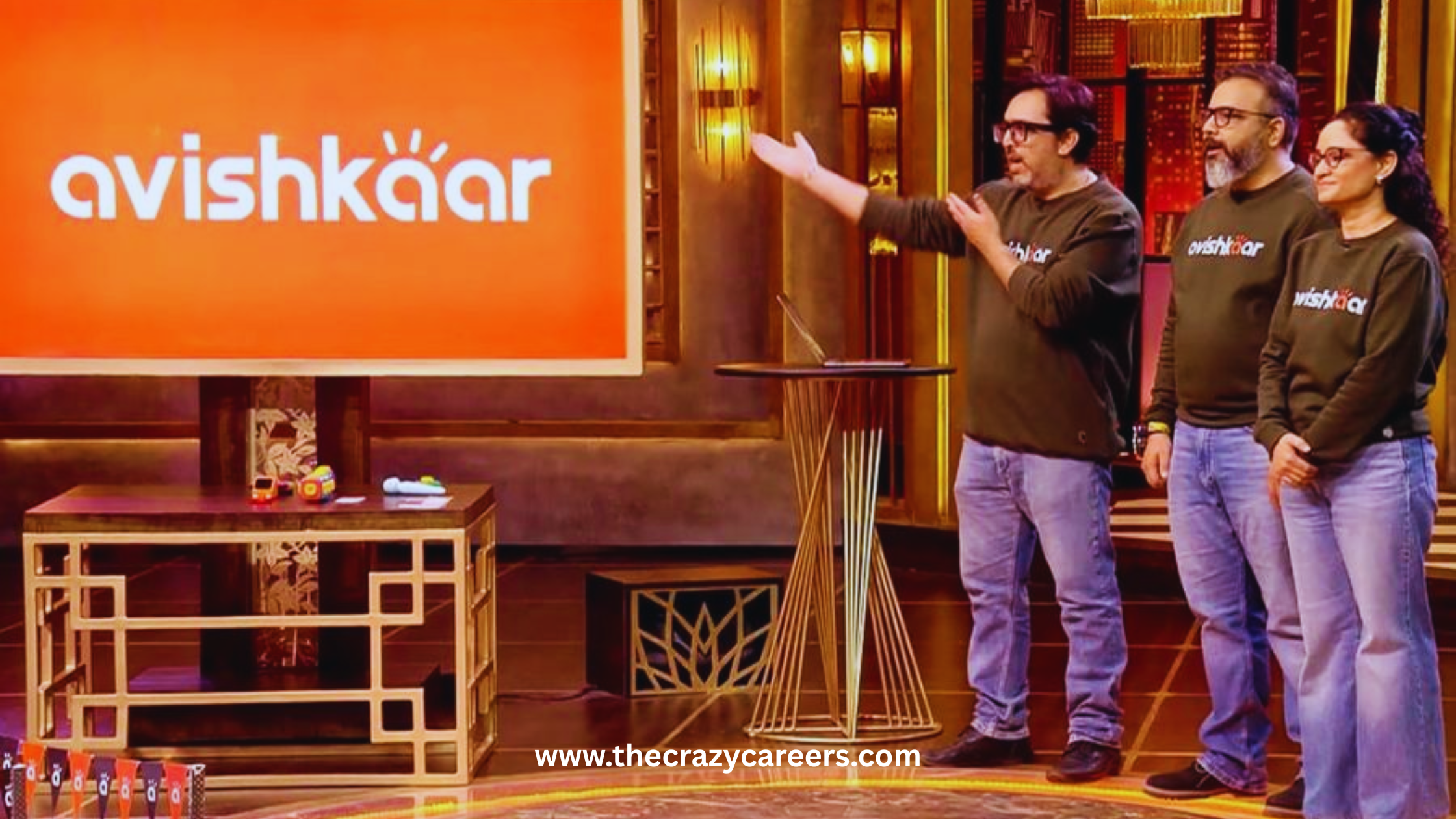
The Indian STEM education space is expanding rapidly, driven by robotics, coding, and AI-based learning tools for children. Yet, even high-growth startups can struggle to convince investors if core questions around positioning and scalability remain unclear. That’s exactly what happened when STEM education startup Avishkaar appeared on Shark Tank India Season 5. Here’s a glimpse of Avishkaar Startup Story.
Despite solid B2B traction, global presence, and improving financials, the startup walked away without a deal. Here’s a detailed breakdown of why Avishkaar failed to secure investment and what founders and edtech entrepreneurs can learn from the pitch.
Avishkaar’s Business Model and Product Portfolio
Avishkaar is a STEM learning startup founded by Tarun Bhalla, Yogita Bhalla, and Rajeev Gaba. The company builds robotics kits, AI learning modules, and coding platforms designed for children between ages 5 and 15.
Their product range includes:
- Mars Rover and Butler robot kits
- AI-enabled learning modules
- Institutional STEM lab solutions
- A proprietary coding platform for children
- A screen-free coding system called Tweak
The founders emphasized that their products are used in schools, innovation labs, and partner institutions across more than 30 countries. They also claimed to have trained over 10 lakh students through their programs and partnerships.
The Shark Tank India Pitch and Valuation Ask
During the pitch, the founders asked for ₹80 lakh for 1% equity, placing the company’s valuation at ₹80 crore. They positioned Avishkaar as a hybrid STEM ecosystem combining hardware kits, curriculum, and platform-based learning.
A major highlight was Tweak, their screen-free coding system built on logic blocks. According to the founders, it works across 14 learning phases, supports nearly one lakh combinations, and holds patents in five countries. The product was presented as a differentiator in a screen-saturated learning environment.
While the innovation aspect impressed the panel, questions quickly shifted toward clarity of market focus and brand positioning.
Revenue Numbers Were Strong – But Not Convincing Enough
From a financial standpoint, Avishkaar showed steady growth and improving profitability:
- FY23 revenue: ₹7.63 crore — ₹44 lakh loss
- FY24 revenue: ₹10.36 crore — ₹57 lakh profit
- FY25 revenue: ₹13.36 crore — ₹2.31 crore profit
- Projected revenue: ₹26–27 crore, with ₹15 crore already achieved
These numbers indicated momentum and operational improvement. However, investors on the panel were not fully convinced that the growth story translated into a sharp, scalable investment opportunity.
Strong revenue alone did not offset concerns about business complexity and category clarity.
Key Concerns Raised by the Sharks
The Sharks expressed multiple strategic concerns that ultimately led to no deal.
Too Many Moving Parts: One of the Sharks remarked that the business resembled its robotics kits with “too many moving parts.” The company operates across hardware, curriculum, labs, platforms, and tools, which made the model appear scattered rather than focused.
Lack of Market Clarity: Investors struggled to categorize Avishkaar clearly:
- Is it a product company?
- A curriculum provider?
- A platform business?
- A school lab solutions vendor?
This lack of a sharply defined category made it harder to assess scalability and competitive moat.
Inconsistent Brand Positioning: The panel also pointed out that the brand messaging did not present a single, memorable positioning. With multiple offerings and audiences, the brand story felt diluted rather than sharply differentiated.
Timing Advantage Didn’t Fully Land
The pitch came at a time when discussions are growing around introducing AI learning at earlier school grades in India from the 2026–27 academic cycle. This policy direction could significantly boost demand for STEM and AI education tools.
However, investors felt that Avishkaar had not yet demonstrated how it would uniquely capture and dominate that upcoming wave versus competitors.
Also Read | Save Sage Wins ₹4 Crore Deal on Shark Tank India
Key Takeaways for EdTech and STEM Startups
Avishkaar’s no-deal outcome highlights an important startup lesson: traction and revenue are not enough without clarity.
Investors look for:
- Sharp positioning
- Clear category leadership
- Simple, scalable business models
- Strong brand identity
- Focused go-to-market strategy
For STEM and edtech founders, the message is clear — innovation must be matched with crisp storytelling and strategic focus to unlock investor confidence.